

Air yards count the total distance a ball travels in the air on pass targets, regardless of whether they are caught. A receiver with lots of air yards is being used downfield, which implies touchdown upside even if his catch rate is modest.
An alpha wide receiver is the clear number-one target on his offense, commanding a target share of 25% or more. Alphas usually profile as WR1 fantasy assets and rarely bust on a given Sunday because their volume floor is so high.
A breakout season is when a player significantly outperforms his prior-year production, usually because of an expanded role, a new offense, or a step forward in efficiency. Breakout candidates are often second-year and third-year pros.
A committee backfield splits carries and receiving work between two or more running backs. Committees create weekly guessing games for fantasy managers because touches can tilt from one back to another based on game script.
A deep threat is a wide receiver who specializes in catching passes 20+ yards downfield. Deep threats are boom-bust by nature because their usage depends on matchups and weekly game-planning.
Game script is how a game flows based on the score. A positive game script means your team is leading, so rushing attempts go up. A negative game script means chasing, so passing attempts go up. Game script determines which players eat on a given Sunday.
Garbage time refers to fantasy production accumulated in blowouts, usually through late-game passing yards and empty-calorie receptions. Garbage time points are real points on the scoreboard, but they are less predictive of future production than actual competitive-game usage.
A goal line back is the running back who comes in for short-yardage and red zone carries. In a committee backfield, the goal line back usually scores more touchdowns but handles fewer snaps than his partner.
A possession receiver specializes in reliable short and intermediate catches. He moves the chains and keeps drives alive but does not add much ceiling unless he sees target share in the 20%+ range.
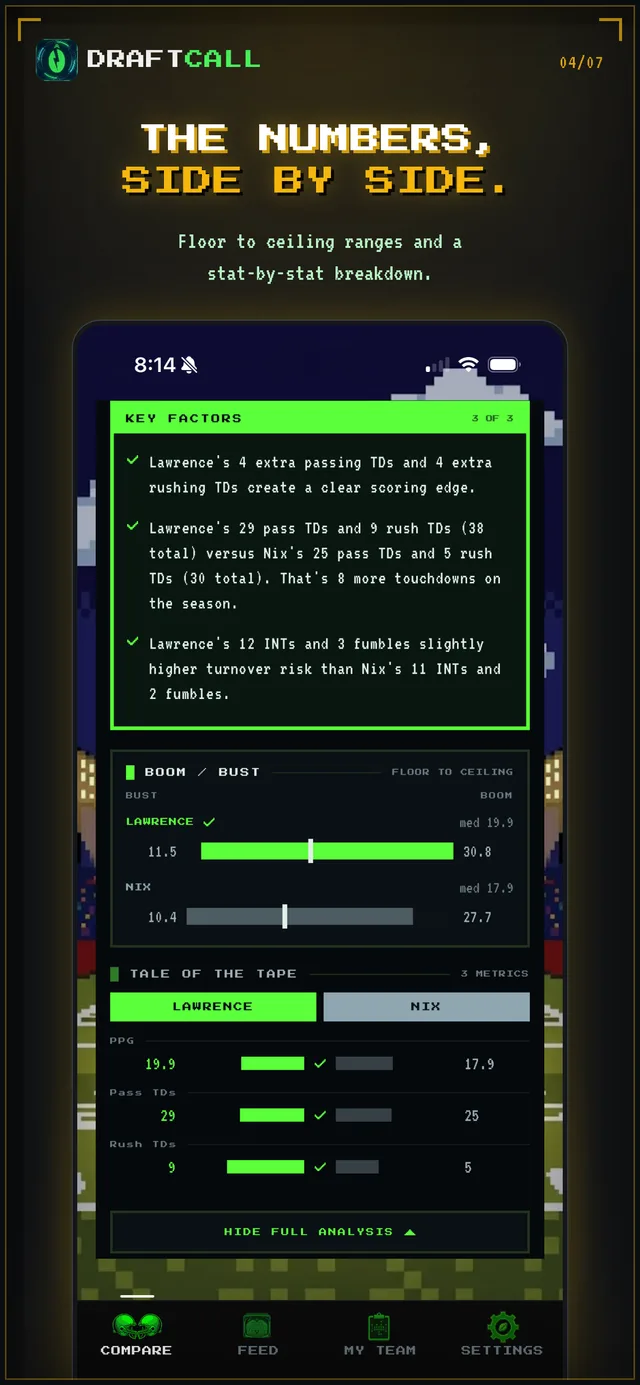
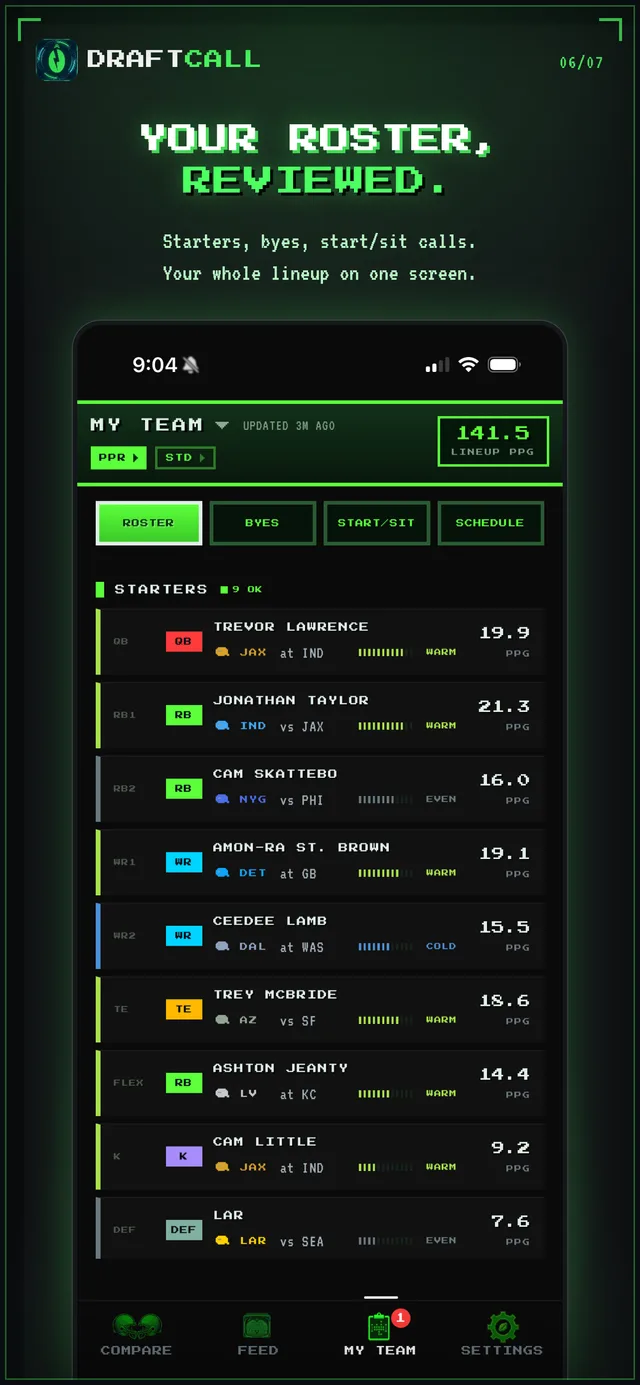
Points Per Game is a player's average fantasy production per game played. PPG is the baseline number every ranking and projection starts from, and it is the single most important metric on any player page on DraftCall.
Red zone touches are carries and targets inside the opponent's 20-yard line. Players with high red zone usage score more touchdowns because most scoring comes from inside the 20. Red zone volume is the single strongest predictor of touchdown regression.
A slot receiver lines up inside the formation rather than wide, working short and intermediate routes over the middle of the field. Slot receivers usually have high PPR floors because their targets come on high-percentage catches.
Snap share is the percentage of offensive plays a player is on the field for. A 75% snap share is a full-time starter; 50% usually means a time-share. Snap share separates real workloads from empty box scores.
Target share is the percentage of a team's passing targets that go to one receiver. A 25% target share is elite, 20% is strong, and anything under 15% puts real pressure on touchdowns to sustain fantasy value. Target share predicts future production better than raw receptions.
A three-down back plays on every type of offensive snap: rushing downs, passing downs, and third downs. Three-down backs earn passing-game targets that give them a reliable PPR floor even in negative game script.
A workhorse running back handles both early-down carries and passing-game work without splitting touches. Workhorses are the rarest and most valuable fantasy assets because they have both a high floor and a high ceiling every week.
Yards After Catch is how many yards a receiver gains after the reception, compared to the air yards on the target. Elite YAC receivers create fantasy points on short, high-percentage targets that other receivers would not convert.