

DraftCall
DraftCallFantasy Football
Chapter 5 of 6

Chapter 5 · Fantasy Football 101

How to Win Your Fantasy League

Weekly lineup decisions, waivers, trades, and the playoff push explained.

A great draft gets you to the starting line, but winning a fantasy league is about what you do during the 17-week season that follows. Good in-season managers gain two to three full wins a year on bad managers with identical rosters, just through smarter weekly decisions. This chapter walks through the four big in-season activities: setting your lineup, working the waiver wire, making trades, and preparing for the playoffs.

These skills compound over the course of a season. The manager who is 1% better at waivers gets one or two extra wins. The one who is 1% better at trades gets another. String those together for 17 weeks and you are suddenly the league's top seed heading into the playoffs. None of this is hard — it is mostly about having a routine and sticking to it.
Weekly lineup decisions

Every fantasy week comes down to a handful of close start/sit calls. You already know who your WR1 and RB1 are — those are locks. The decisions that actually matter are in the FLEX slot and at tight end, where you usually have two or three players fighting for one or two starting slots and the gap between them is small.

The factors to weigh for each close call: season-long production, recent trend (last three games), matchup quality (opponent's defensive rank against the position), game script (is this player's team favored, underdog, or in a pick'em?), and injury status. Nobody wins every start/sit call, but if you win 55-60% of them, you are playing winning fantasy football.

Most managers set their lineup early in the week and forget about it until kickoff. That is a mistake. News changes all week — injuries happen on Friday, a starter gets ruled out on Saturday, a weather forecast turns ugly on Sunday morning. Check your lineup at least twice: once on Thursday after the primetime game finishes, and once on Sunday morning before the early games kick off.

The waiver wire

The waiver wire is the pool of all unrostered players in your league. When a player has a breakout game, you want him on your bench before the rest of the league does. Waivers process once or twice a week (usually Tuesday night or Wednesday morning, depending on your league), and the pickup order matters a lot.

There are two main waiver systems. Rolling waivers give every manager a priority number, and the lowest number gets first pick each week. When you use your priority to pick someone up, you drop to the bottom of the order. FAAB (Free Agent Acquisition Budget) gives every manager a budget (usually $100) and you bid on players. Highest bid wins, highest bid loses that budget. FAAB rewards strategy over luck, which is why most serious leagues use it.

Your waiver goal is to trade roster spots that are not contributing for roster spots that might. If a player on your bench has been dropped in the first-team running back role for three weeks and is clearly a lost cause, he should be the cut when you pick up a hot waiver target. Do not hang on to draft-day picks out of stubbornness — the waiver wire is where leagues are won.

Trades — when to buy, when to sell

Trading is the most under-used tool in beginner fantasy football. Most rookie managers never make a trade at all, which is leaving wins on the table. A smart trade combines a position of strength with a position of weakness to produce a more balanced starting lineup. Both sides can win if the trade addresses a real need for each team.

The best time to buy a player is after one or two bad games from a guy you still believe in. His owner is frustrated, might be starting to question the pick, and is more likely to accept a trade. The best time to sell is after a breakout game. His owner (you) is celebrating, but one great week rarely reflects a sustainable new baseline. Trade the hype up, buy the disappointment low.

Most leagues have a trade deadline around Week 10 or 11. After the deadline you cannot trade anymore — you have to work with your current roster through the playoffs. That gives you about 8-9 weeks of trade windows. Do not wait until Week 10 to make your first move; by then the good trade partners have already been picked over.

Reacting to injuries and news

NFL injuries happen constantly. A starting running back goes out with a hamstring strain on Monday and your entire week changes. The managers who win leagues are the ones who react fast and rationally instead of panicking. Check injury reports Thursday, Friday, and Saturday every week — not because you are obsessive, but because a 30-second check can save you a loss.

When an injury happens, the immediate question is: who benefits? If your starting RB gets injured, you are looking at his handcuff first (did you draft him? — you should have). If a teammate at the same position, the backup tight end might suddenly see 70+ snaps a game. The waiver wire activity around injuries is where the hot picks come from.

Do not panic-drop injured players. A "questionable" tag usually means 50-50, and a "doubtful" tag means 25% chance of playing. Those are not zero. Keep injured starters on your bench for at least one more week if there is any chance they return, especially at running back where replacement-level options are thin.

The playoff push

Fantasy playoffs usually run in Weeks 15, 16, and 17 of the real NFL season. Top 4 or 6 teams make it, depending on your league. Once the playoffs start, your regular-season stats do not matter anymore — you either win each week and advance, or you lose and you are out.

The playoff push is Weeks 10 through 14. These are the games that decide seeding, which is the difference between a home matchup against the 6th seed and a road matchup against the 3rd seed. Do not coast — every win matters, especially if your league uses total points as a tiebreaker.

Roster decisions during playoffs get weird. NFL teams that are locked into playoff seeds sometimes rest starters in Week 17 or 18 (most fantasy playoffs do not include Week 18 for exactly this reason). Check the real-life playoff standings every week starting at Week 13 and plan accordingly. A starter who suddenly becomes a Week 17 rest candidate is a liability, not an asset.

Glossary Terms From This Chapter

Website vs App

Put it into action

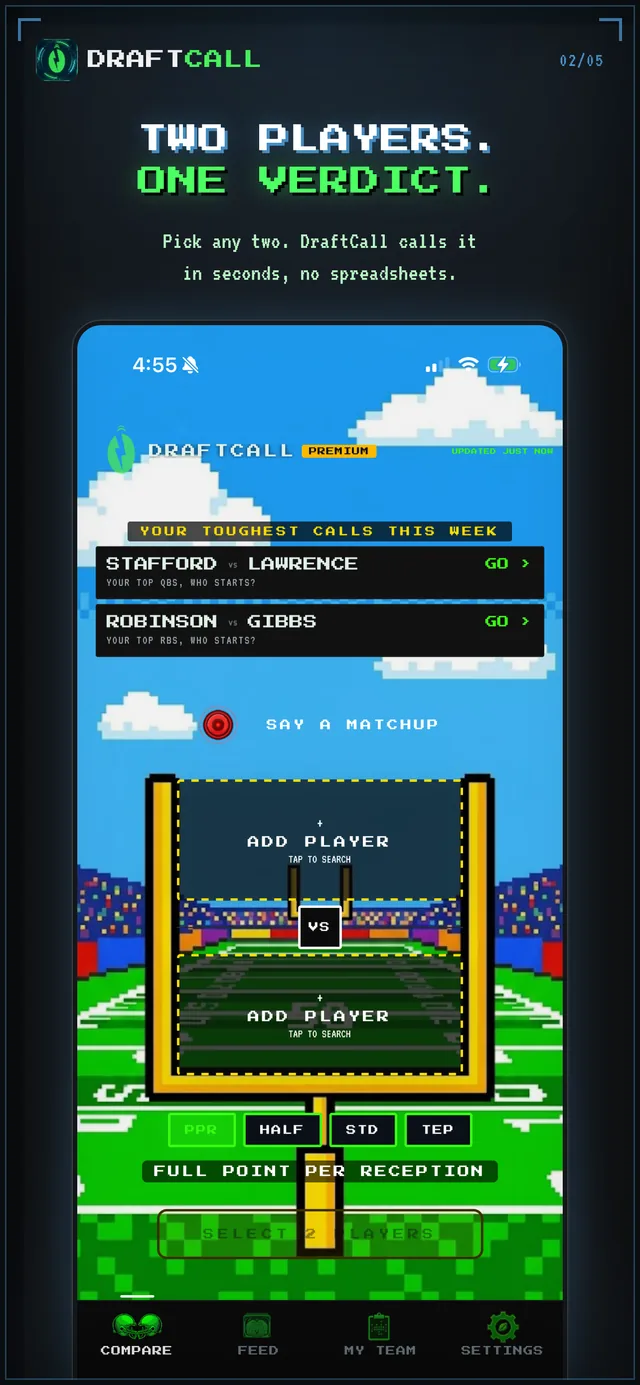
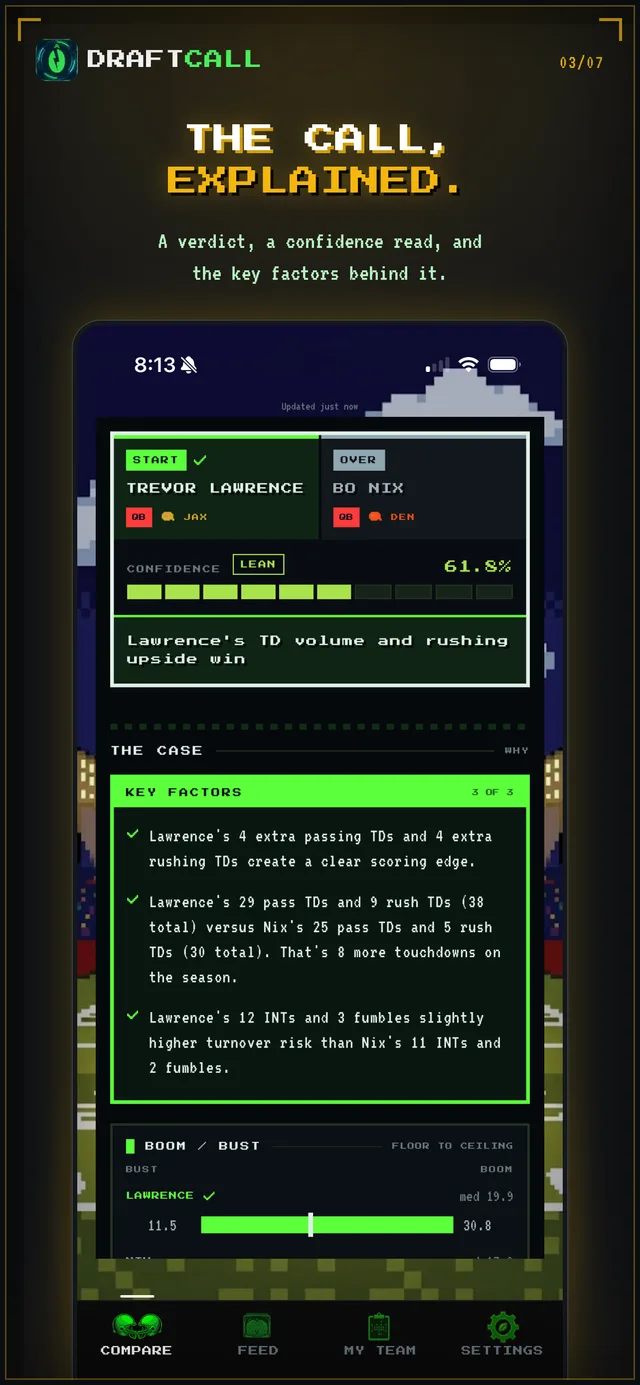
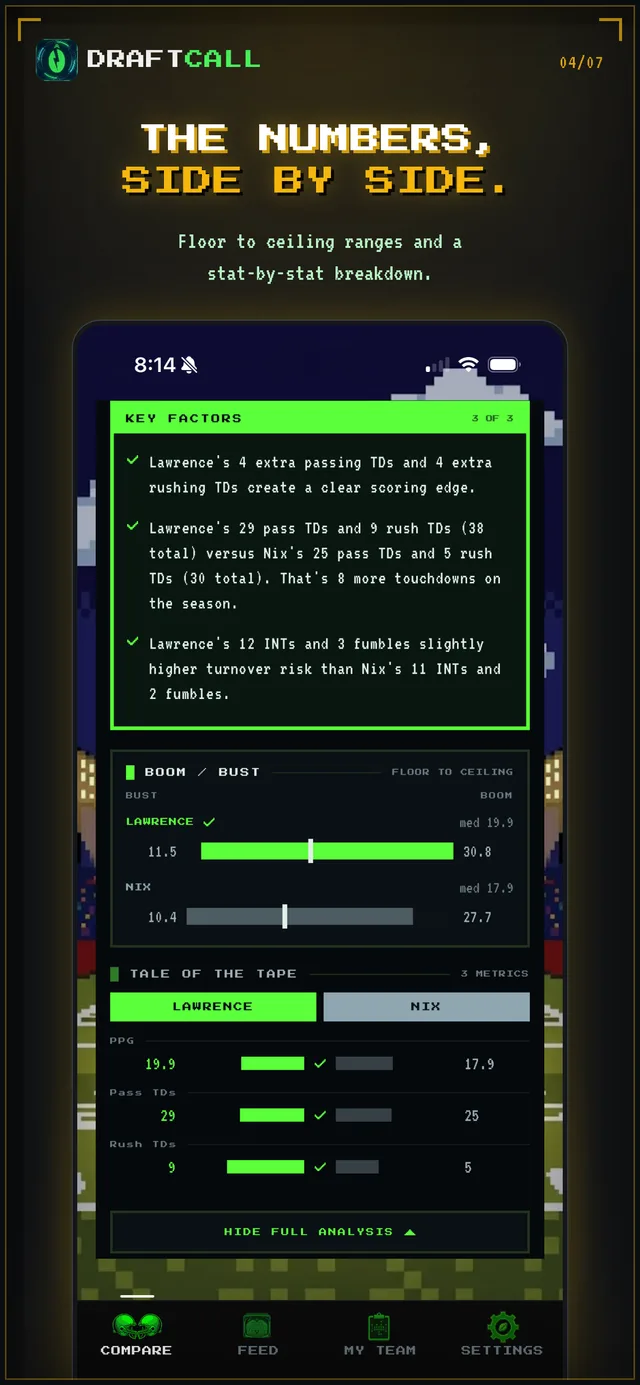
DraftCall's AI comparison engine gives you clear start/sit verdicts in seconds, so the knowledge from this chapter turns into real fantasy wins.

See everything in the app →